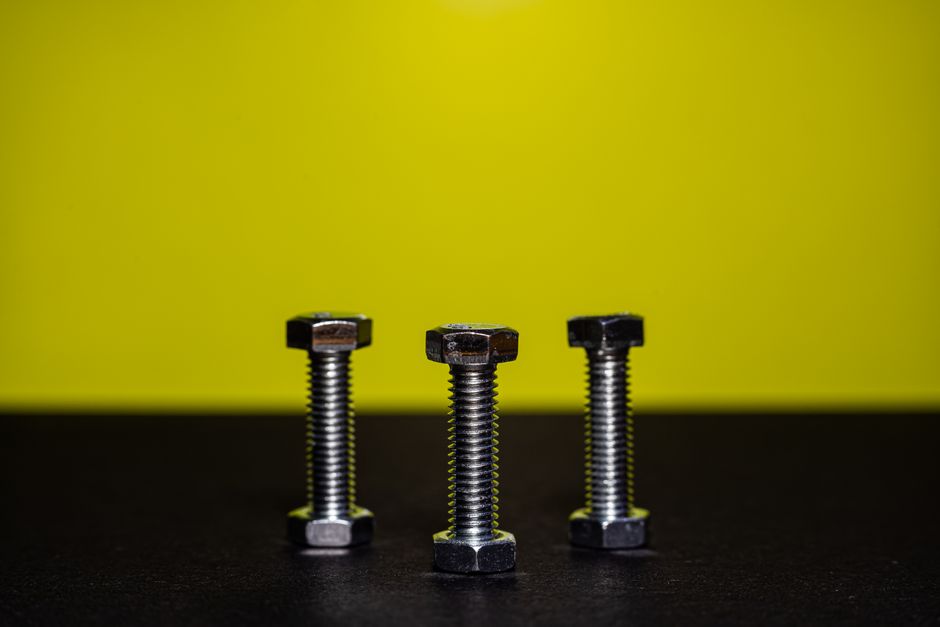
 Photo by Győző Mórocz on Pexels
ISO 898-1 is the international metric bolt grade standard used across the UK and EU. ISO 898-1 vs ASTM A307: Bolt Grade Standards Compared ASTM A307 is the American imperial equivalent for general-purpose carbon steel bolts. They're NOT direct grade-for-grade equivalents - the grade naming systems differ, the thread systems differ, and the strength levels line up only roughly. UK engineers sourcing US equipment or imports need to understand both.
ISO 898-1 vs ASTM A307 comparison
| Property | ISO 898-1 (metric) | ASTM A307 (inch) |
|---|
| Region | International, standard in UK / EU | USA / imperial |
| Unit | MPa | ksi (kilopounds per square inch) |
| Typical lowest grade | Class 4.6 (400 MPa tensile) | Grade A (60 ksi / 414 MPa tensile) |
| Mid grade | Class 8.8 (800 MPa tensile) | Grade B (60 ksi / 414 MPa tensile) |
| High grade | Class 10.9, 12.9 (1040, 1220 MPa) | A325 / A490 (covered by separate specs) |
| Grade stamp on head | '8.8', '10.9', '12.9' | No stamp (or just 'A307') |
| Size range | M1.6 to M39 | 1/4 inch to 4 inch |
| Thread standard | ISO 261 metric | ANSI B1.1 UNC/UNF |
Closest strength equivalents (not exact)
| ISO 898-1 Class | Tensile (MPa) | Nearest ASTM equivalent |
|---|
| 4.6 | 400 | ASTM A307 Grade A / B (414 MPa) |
| 5.8 | 520 | no exact A307 equivalent |
| 8.8 | 800 | ASTM A325 (830 MPa for sizes up to 1 inch) |
| 10.9 | 1040 | ASTM A490 (1034 MPa) |
| 12.9 | 1220 | no standard US equivalent; special specifications |
When to use ISO 898-1 (metric)
All new UK and EU projects should specify ISO 898-1 classes. It's what British and European manufacturers stamp on their bolts. The grade stamp is standardised (8.8, 10.9, 12.9) and immediately visible on the head. Tensile and proof loads are clearly defined.
When you'll encounter ASTM A307
Typically on imported US equipment, oil and gas projects referencing ANSI standards, and legacy UK plant built pre-1980. If you see no grade stamp on a hex bolt, it's most likely either ASTM A307 (USA) or a low-grade class 4.6 or 5.8 ISO bolt. Measure and test if a safety-critical application.
Bolt assortments + torque tools
Shop the exact parts and tools referenced above on Amazon UK. Prices, stock, and delivery times update live; MLC earns a small commission on qualifying purchases at no cost to you.
As an Amazon Associate, MLC earns from qualifying purchases. The product links on this page support our work at no extra cost to you.
Frequently Asked Questions
Is ISO 898-1 class 8.8 the same as ASTM A307?
No. ISO 898-1 class 8.8 has 800 MPa minimum tensile strength. ASTM A307 has only 414 MPa (Grade A or B). The closer US equivalent to class 8.8 is ASTM A325 at 830 MPa. Never substitute an A307 bolt for a class 8.8 without a proper strength calculation.
What does the 8.8 mark on a bolt head mean?
The 8.8 designation per ISO 898-1 encodes two values. The first number x 100 gives minimum tensile strength in MPa (so 8 means 800 MPa). The second digit is 10x the yield-to-tensile ratio (so 8 means yield = 80% of tensile = 640 MPa). A class 10.9 bolt has 1040 MPa tensile and 940 MPa yield.
Are ASTM A307 bolts safe for structural use?
A307 bolts are general-purpose carbon steel and are NOT intended for structural steelwork. Structural US projects typically use ASTM A325 (equivalent to ISO class 8.8) or A490 (equivalent to class 10.9). UK structural work specifies class 8.8 or 10.9 per BS EN ISO 898-1 and BS EN 1090.
Can I substitute an imperial bolt for a metric one?
No — metric and imperial threads are not interchangeable. M10 x 1.5 has a 10 mm major diameter and 1.5 mm pitch; the closest imperial size (3/8 inch UNC) has 9.525 mm major and 1.588 mm pitch (16 TPI). Always match the thread system; substitute the GRADE only after checking proof loads match.
What are the typical tensile strength levels for the lowest grades of ISO 898-1 and ASTM A307 bolts?
The typical lowest grade in ISO 898-1 vs ASTM A307: Bolt Grade Standards Compared is Class 4.6 with a tensile strength of 400 MPa, while for ASTM A307 it's Grade A with a tensile strength of 60 ksi (equivalent to 414 MPa).
What are the main differences in grade naming systems between ISO 898-1 and ASTM A307?
In ISO 898-1 vs ASTM A307: Bolt Grade Standards Compared, ISO uses a two-digit system like '8.8' or '10.9', whereas ASTM employs letter designations such as 'Grade A' and 'Grade B'. These systems don't directly equate in terms of grade levels.
How does one choose between metric ISO 898-1 bolts and imperial ASTM A307 bolts for a project?
When choosing between ISO 898-1 vs ASTM A307 standards, UK engineers should consider the thread standard (metric for ISO, inch for ASTM) and ensure compatibility with existing equipment. The tensile strength of the required grade is also important to match.
What are the size ranges covered by ISO 898-1 and ASTM A307 bolt grades?
In ISO 898-1 vs ASTM A307: Bolt Grade Standards Compared, ISO covers sizes from M1.6 to M39, while ASTM A307 spans from 1/4 inch to 4 inches.
Are there any UK suppliers that stock both metric ISO 898-1 and imperial ASTM A307 bolts?
Many UK suppliers offer a range of bolt grades including ISO 898-1 and occasionally carry the imperial standard ASTM A307 as well, ensuring compatibility for projects involving US equipment or materials.
What is the cost comparison between ISO 898-1 and ASTM A307 bolts in the UK market?
Costs can vary widely depending on availability; typically, metric ISO 898-1 bolts are more commonly stocked and thus potentially less expensive than imperial ASTM A307 bolts, which may require special ordering.