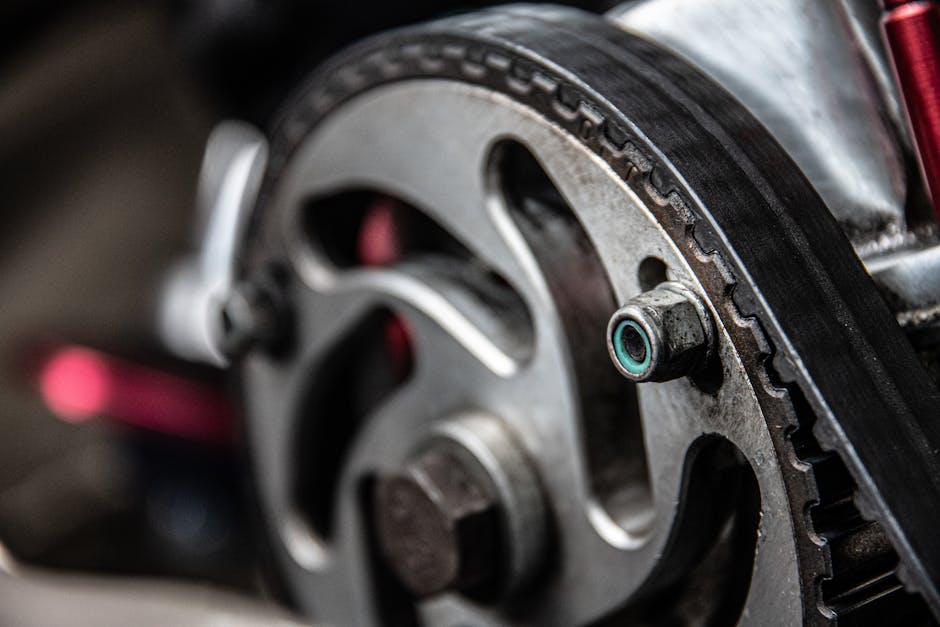
 Photo by Hebert Santos on Pexels
How Do I Choose the Right V-Belt Profile?
When selecting a V-belt profile, start by identifying if you're working within narrow-section profiles like SPZ, SPA, SPB, or SPC, which are prevalent in UK applications due to their space efficiency and energy savings. V-Belt and Timing Belt Selection Guide For classical profiles such as Z, A, B, C, opt for them only when retrofits or specific machinery requirements dictate.
What Are the Steps to Select a V-Belt?
To select the right V-belt, follow these steps:
- Calculate Design Power: Determine the design power by multiplying motor kilowatts (kW) by the service factor. For instance, if your motor is 5 kW and you're using a service factor of 1.25, your design power would be 6.25 kW.
- Select Belt Section: Use power/speed charts to choose the correct belt section based on your calculated design power. These charts can often be found in manufacturers' catalogues or online resources.
- Calculate Belt Length: Determine the belt length using the formula \( L = 2C + \frac{\pi(D+d)}{2} + \frac{(D-d)^2}{4C} \), where \( C \) is the centre distance between pulleys, and \( D \) and \( d \) are the diameters of the larger and smaller pulley, respectively.
- Determine Number of Belts: Calculate how many belts you need based on the power each belt can handle. This information is usually provided in manufacturers' specifications or data sheets.
What Are Timing Belt Profiles?
For timing belts, choose from HTD (curvilinear), AT, and T profiles. HTD is the most common due to its superior performance and durability, especially for high-torque applications.
How Do I Choose the Right Timing Belt Pitch?
Selecting the right pitch depends on your application's torque requirements. Higher pitches like 14M are better suited for higher torques compared to lower pitches such as 3M or 5M, which offer more flexibility and speed capability but less power transmission.
What Are the Key Considerations When Calculating Belt Length?
Calculating belt length accurately is critical. Use the formula \( L = 2C + \frac{\pi(D+d)}{2} + \frac{(D-d)^2}{4C} \). Ensure you measure the centre distance (\( C \)) and pulley diameters (\( D \) and \( d \)) precisely to avoid errors. This calculation helps in determining the correct length of your V-belt or timing belt.
How Do I Tension a Belt Properly?
Proper tensioning ensures optimal performance and longevity of your belts. Use either the deflection method or frequency method:
- Deflection Method: Measure the vertical displacement when applying a known force at mid-span. At V-Belt and Timing Belt Selection Guide, this should typically be around 1/64 inch per inch of belt width for V-belts.
- Frequency Method: Adjust tension until the resonant frequency is within specified limits, usually found in manufacturers' guidelines.
Always refer to ISO standards such as ISO 5292 (V-belts) and ISO 5294 (V-pulleys) for additional guidance on belt and pulley dimensions and performance parameters.
Related reference pages: timing belt length calculator.
Frequently Asked Questions
What does this guide cover?
This guide covers v-belt and timing belt selection guide with practical selection criteria, real specifications, and references to ISO and BS standards. Written for UK engineers and procurement professionals.
What is the V-Belt and Timing Belt Selection Guide?
The V-Belt and Timing Belt Selection Guide provides UK engineers with detailed information on selecting appropriate belt types based on application requirements, including power transmission needs and mechanical compatibility. It covers various profiles like narrow-section SPZ to classical Z profiles.
Which types of V-belts are commonly used in the UK according to the guide?
The guide recommends using narrow-section V-belt profiles such as SPZ, SPA, SPB, and SPC for space efficiency and energy savings. For retrofits or specific machinery requirements, it suggests classical profiles like Z, A, B, and C.
How do you determine the number of V-belts needed based on design power?
After calculating your design power using motor kilowatts and a service factor, use power/speed charts from manufacturers' catalogues to select the correct belt section. Then, calculate how many belts are required by dividing your total power requirement by the power capacity of one belt.
What standards should engineers follow when selecting V-belts according to the guide?
Engineers should adhere to ISO and DIN standards for V-belt dimensions and specifications as outlined in the V-Belt and Timing Belt Selection Guide. These standards ensure compatibility across different machines and manufacturers.
Where can I find UK suppliers of V-belts mentioned in the selection guide?
The guide suggests contacting local distributors or manufacturers such as Gates Corporation, Fenner Drive Systems, and Habasit for reliable supply options. These companies offer a wide range of belt types suitable for various industrial applications in the UK.
What are the key differences between V-Belts and Timing Belts according to the V-Belt and Timing Belt Selection Guide?
According to the V-Belt and Timing Belt Selection Guide, V-belts rely on friction for power transmission, making them suitable for applications requiring smooth operation with some level of flexibility in timing. In contrast, timing belts use teeth that engage directly with a mating pulley, ensuring precise synchronous movement, ideal for applications needing accurate speed control.
How does the V-Belt and Timing Belt Selection Guide recommend selecting between narrow-section profiles like SPZ and classical profiles such as Z?
The V-Belt and Timing Belt Selection Guide suggests opting for narrow-section profiles (SPZ, SPA, SPB, SPC) when space efficiency and energy savings are critical, common in UK machinery. For applications requiring specific retrofits or adherence to older machinery standards, classical profiles like Z, A, B, C should be chosen.
What standards does the V-Belt and Timing Belt Selection Guide reference for selecting materials that ensure durability under high temperatures?
The guide references ISO and DIN standards when selecting materials for V-belts and timing belts. Materials such as neoprene or nitrile rubber are recommended for lower temperature applications, while polyurethane is preferred for higher temperatures due to its superior heat resistance.
According to the V-Belt and Timing Belt Selection Guide, what factors should engineers consider when choosing UK suppliers?
Engineers selecting UK suppliers for V-belts and timing belts should prioritize suppliers that offer a wide range of belt profiles and sizes in compliance with international standards. Additionally, availability of technical support, competitive pricing, and quick delivery times are important considerations highlighted by the guide.