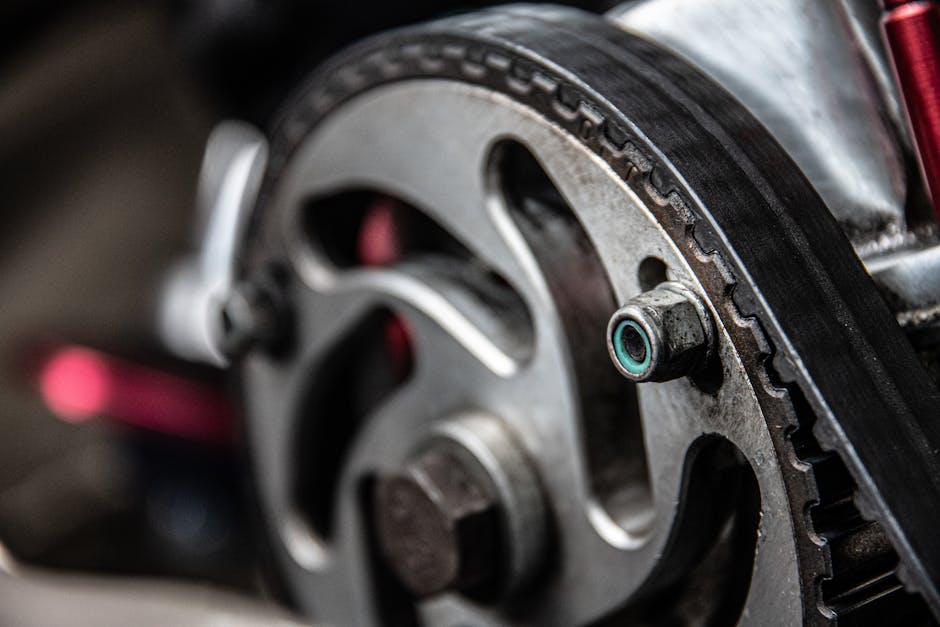
 Photo by Hebert Santos on Pexels
| Specification | Details |
|---|
| Profiles | HTD (3M, 5M, 8M, 14M), AT (AT5, AT10, AT20), T (T5, T10) |
| Standards | ISO 13050 |
| Materials | Neoprene or polyurethane with fibreglass or steel cords |
| Brands | Gates PowerGrip, Optibelt Omega, ContiTech Synchrobelt |
Timing belts, also known as synchronous timing belts or toothed belts, are precision-engineered components used to transmit motion and power between shafts in machinery. They feature a series of teeth that mesh with corresponding grooves on pulleys, ensuring precise synchronization.
Types and variants
Timing belts come in various profiles including HTD (3M, 5M, 8M, 14M), AT (AT5, AT10, AT20), and T (T5, T10). Each profile has distinct dimensions to suit different applications. For instance, the HTD-5M belt is suitable for smaller motors with pulleys having a tooth pitch of 5 millimeters.
Materials and specifications
Timing belts are typically made from neoprene or polyurethane reinforced with fibreglass or steel cords. These materials ensure durability under high loads and temperatures ranging from -40°C to +80°C. The ISO 13050 standard outlines the dimensions, tolerances, and performance criteria for these belts.
Selection criteria
Selecting the right timing belt involves considering factors such as pulley diameter, load requirements, operating environment, and speed. For example, HTD-14M belts are recommended for high-torque applications due to their larger tooth pitch (14mm) which can handle higher loads compared to smaller profiles like HTD-3M.
UK suppliers
MLC lists verified suppliers from Companies House, ensuring that procurement managers have access to reliable sources. For instance, Gates PowerGrip offers a wide range of standard and customised timing belts suitable for various industrial applications.
Common applications
Timing belts are used in diverse industries such as automotive (engine components), manufacturing (conveyors), and robotics (servo motors). Timing Belts provides precise timing and positioning critical for the operation of machinery. In the UK, these belts comply with British Standards like BS ISO 13050, ensuring quality and reliability.
Timing belts are important in modern engineering due to their precision and efficiency. For example, an HTD-8M belt can handle loads up to 25 kgf/cm² at speeds of up to 4 m/s, making it ideal for high-performance machinery. The choice of material-such as neoprene or polyurethane-also plays a important role in the belt's performance and longevity under varying conditions.
In selecting timing belts, engineers must consider not only load requirements but also environmental factors like humidity and chemical exposure. For instance, polyurethane belts are more resistant to oil and chemicals compared to neoprene belts, making them suitable for harsh industrial environments. Additionally, fibre-reinforced belts offer superior strength and flexibility, whereas steel-corded versions provide higher torque transmission capabilities.
MLC's database of UK suppliers ensures that engineers have access to a wide range of timing belt options from reputable manufacturers like Gates PowerGrip and ContiTech Synchrobelt. These suppliers adhere to strict quality standards set by trade bodies such as the British Industrial Fasteners Association (BIAFD) and the British Pump Manufacturers Association (BPMA).
Understanding these specifications and selection criteria helps engineers make informed decisions, ensuring that their machinery operates smoothly and efficiently. By choosing high-quality timing belts from profiled UK suppliers, maintenance engineers can reduce downtime and improve overall productivity.
Frequently Asked Questions
Where can I buy Timing Belts in the UK?
MLC lists verified UK timing belts suppliers with Companies House data. Browse by product category or search by location.
What are Timing Belts used for in machinery?
Timing belts are used to transmit precise motion and power between shafts in machinery, featuring a series of teeth that mesh with corresponding grooves on pulleys to ensure accurate synchronization.
What profiles do Timing Belts come in?
Timing belts come in various profiles including HTD (3M, 5M, 8M, 14M), AT (AT5, AT10, AT20), and T (T5, T10). Each profile is designed to fit different pulley sizes and applications.
How do you choose the right Timing Belt for a specific application?
The choice of timing belt depends on the required power transmission capacity, operating speed, and space constraints. Profiles like HTD-3M are suitable for smaller motors, while larger profiles such as HTD-14M handle higher loads.
What standards do Timing Belts adhere to?
Timing belts adhere to ISO 13050, a standard that defines dimensions and performance criteria for timing belt drives.
Which materials are commonly used in the construction of Timing Belts?
Timing belts are typically made from neoprene or polyurethane reinforced with fibreglass or steel cords, ensuring durability under high loads and temperatures.
Are there specific UK suppliers for Timing Belts?
Popular brands like Gates PowerGrip, Optibelt Omega, and ContiTech Synchrobelt supply timing belts in the UK, offering a range of profiles and materials to meet industrial needs.
How do cost and availability affect choosing a Timing Belt?
The cost and availability of timing belts can vary based on material type and profile size. Polyurethane belts with steel cords are more expensive but offer higher performance, while neoprene belts with fibreglass cords may be less costly and readily available.
Can Timing Belts operate effectively in high-temperature environments?
Timing belts made from polyurethane reinforced with steel cords can withstand higher temperatures compared to those made of neoprene with fibreglass reinforcement, making them suitable for industrial applications where heat is a factor.