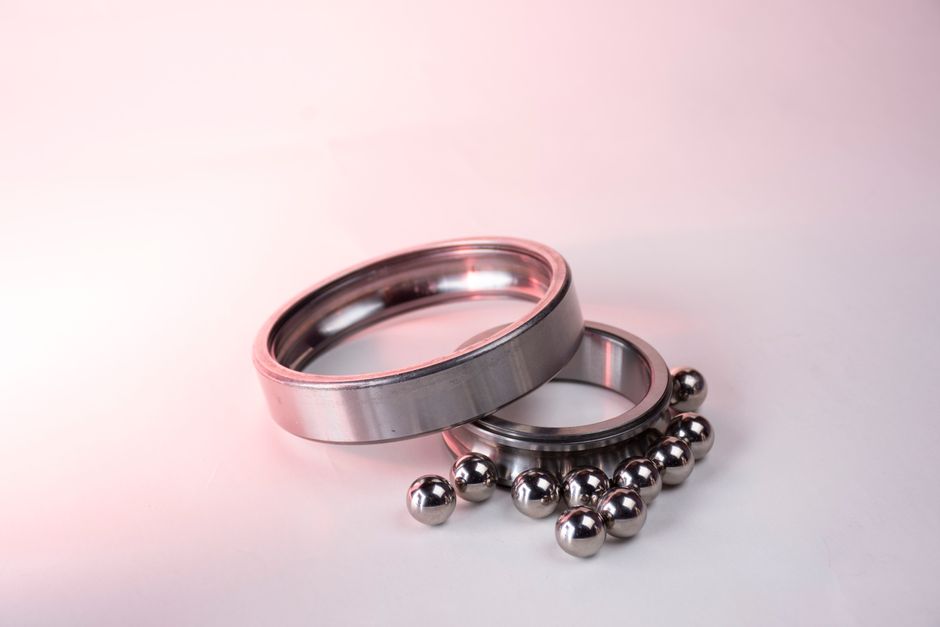
 Photo by Marcelo Avila on Pexels
| Specification | Details |
|---|
| Types | Deep groove ball, angular contact, taper roller, needle roller, thrust, spherical, linear |
| Materials | Chrome steel (52100), stainless (440C), ceramic (Si3N4), polymer |
| Standards | ISO 15, ISO 355, ISO 492, ISO 5753 |
| Brands | SKF, NSK, FAG/Schaeffler, Timken, NTN, INA, NACHI |
What are Bearings?
Bearings are mechanical components designed to reduce friction and support rotating or linearly moving parts by maintaining their relative positions and minimizing wear.
Types of Bearings
Deep groove ball bearings are ideal for applications requiring high speeds and radial loads, like motors and gearboxes. Angular contact bearings handle axial loads well, making them suitable for machine tools. Taper roller bearings excel in heavy-duty thrust applications such as axle shafts. Needle roller bearings offer a compact solution with high load capacity, often used in transmissions. Thrust bearings are designed specifically to support axial loads, common in gear sets and pumps. Spherical plain bearings accommodate misalignment due to their ball-and-socket design, beneficial for agricultural equipment. Linear bearings provide smooth linear motion for machine tools.
Materials and Specifications
Bearings can be made from various materials including chrome steel (52100), stainless steel (440C), ceramics (Si3N4), and polymers. Chrome steel is the most common due to its durability, while stainless steel offers corrosion resistance. Ceramics provide high hardness and low friction coefficients but are more expensive. Materials must comply with standards like ISO 15 for deep groove ball bearings or DIN 720 for tapered roller bearings.
Selecting the right bearing involves considering load type, speed requirements, operating environment, and maintenance needs. For instance, angular contact bearings are ideal for high-speed applications but not suitable for heavy radial loads. Always consult manufacturer ratings like the Basic Load Rating (BL) from ISO 281 when comparing different types.
UK Suppliers
MLC lists verified suppliers registered with Companies House, ensuring reliability and quality across a range of bearing brands such as SKF, NSK, FAG/Schaeffler, Timken, NTN, INA, and NACHI. These companies adhere to industry standards and offer full product ranges suitable for various industrial applications.
Common Applications
Bearings are widely used in industries including automotive (steering systems), aerospace (engine components), manufacturing (assembly lines), and construction (cranes). For example, deep groove ball bearings are found in electric motors, while taper roller bearings support heavy-duty machinery like conveyor belts. Angular contact bearings are critical for precision applications such as CNC machines.
In summary, Bearings play a important role in maintaining the efficiency and longevity of mechanical systems through their ability to reduce friction and absorb loads. Careful selection based on application-specific needs ensures optimal performance and reliability.
Bearings listings on MLC cover products including ball bearing bearings and bearing puller. All suppliers are verified against Companies House public records.
Profiled UK bearings suppliers
MLC lists 50 verified bearings suppliers, each cross-referenced against Companies House public records.
| Company | Company No. | Incorporated | Status |
|---|
| Joyce Services & Co Limited | 12931009 | 2020-10-06 | Dissolved |
| Senco 2017 Limited | 07316337 | 2010-07-15 | Dissolved |
| Zeitlauf Gearmotors Limited | 05415528 | 2005-04-06 | Dissolved |
| Springco (N.I.) Limited | NI003360 | 1954-05-10 | Active |
| Guru Nanak Aerospace Uk Ltd | 12348300 | 2019-12-04 | Active |
| Stellar Skin Ltd | 13883137 | 2022-01-31 | Dissolved |
| Darpol Logistics Ltd | 11264963 | 2018-03-20 | Active |
| Huaxing Technology Limited | 13793781 | 2021-12-10 | Dissolved |
| Yue Micro Limited | 13793786 | 2021-12-10 | Dissolved |
| Velowax Ltd | 12597538 | 2020-05-12 | Dissolved |
Plus 40 more verified suppliers. Browse the full list on MLC.
Companies sourced from Companies House SIC codes: 28150. Data verified April 2026.
UK trade in bearings, 2025
The UK imported £259.7 million of bearings in 2025, 11 thousand tonnes by weight, and exported £225.6 million. £169.2 million of imports came from the EU and £90.4 million from outside it. Figures are compiled from HM Revenue & Customs Overseas Trade Statistics across 4 commodity headings, covering all four HMRC trade flows (HMRC UK Trade Info).
Largest sources of imports:
| Country | Import value | Share |
|---|
| Germany | £66.5 million | 25.6% |
| United States | £53.0 million | 20.4% |
| Belgium | £35.0 million | 13.5% |
| France | £34.1 million | 13.1% |
| China | £15.9 million | 6.1% |
| Italy | £9.7 million | 3.7% |
Named countries account for 96% of import value; the remainder is spread across smaller partners.
By commodity heading:
- 848210 — Ball bearings: £152.6 million
- 848220 — Tapered roller bearings, incl. cone and tapered roller assemblies: £62.3 million
- 848230 — Spherical roller bearings: £28.2 million
- 848240 — Needle roller bearings, incl. cage and needle roller assemblies: £16.5 million
Contains public sector information licensed under the Open Government Licence v3.0. Full dataset: uk-engineering-component-trade.
Frequently Asked Questions
What types of Bearings are available in the UK?
Bearings are available from hundreds of UK suppliers in various materials, sizes, and specifications. Browse MLC's verified supplier listings for current stock and technical specs.
How do I choose the right Bearings?
Selecting the right Bearings depends on load requirements, operating environment, temperature range, and material compatibility. Check our buying guides for detailed selection criteria.
Can I buy Bearings in small quantities?
Many UK Bearings suppliers offer no minimum order quantities. Filter suppliers on MLC to find those selling individual items or small batches.
Are Bearings suppliers on MLC verified?
All suppliers listed on MLC are verified against Companies House public records. Each listing shows incorporation date, company status, directors, and registered address.
What standards apply to Bearings?
Bearings are manufactured to various ISO, BS, and DIN standards depending on type and application. Check individual product pages for specific standard references.
What are Bearings and why are they important in mechanical engineering?
Bearings are mechanical components designed to reduce friction and support rotating or linearly moving parts. They're critical for maintaining the efficiency, reliability, and longevity of machinery by minimizing wear.
Which types of Bearings are available and suitable for high-speed applications like motors and gearboxes?
Deep groove ball bearings are ideal for high-speed and radial load applications such as motors and gearboxes due to their efficient design. Angular contact bearings also handle axial loads well, making them suitable for precision machine tools.
What materials are commonly used in Bearings, and which material is best for corrosion resistance?
Common materials include chrome steel (52100), stainless steel (440C), ceramic (Si3N4), and polymer. Stainless steel bearings provide superior corrosion resistance compared to other materials due to their inherent properties.
Which standards are relevant when selecting Bearings, and how do they impact performance?
Relevant standards include ISO 15, ISO 355, ISO 492, and ISO 5753. These standards ensure the quality, durability, and compatibility of bearings by specifying dimensions, tolerances, and testing methods.
Where can UK engineers find high-quality Bearings from reputable brands?
Engineers in the UK can purchase Bearings from well-known brands such as SKF, NSK, FAG/Schaeffler, Timken, NTN, INA, and NACHI. These suppliers provide a wide range of bearing types to meet various industrial needs.