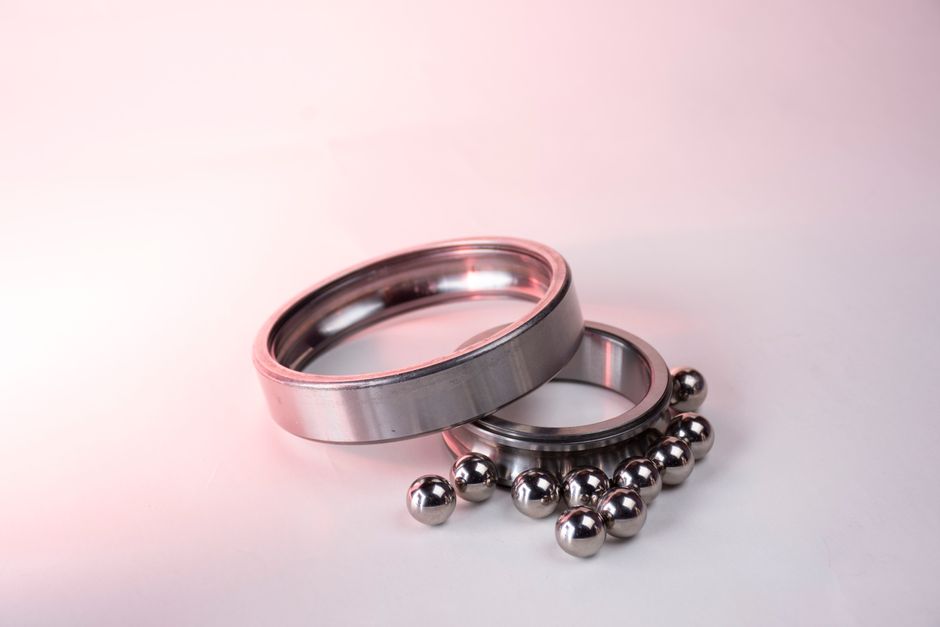
 Photo by Marcelo Avila on Pexels
Calculate basic L10 bearing life from dynamic load rating (C), equivalent dynamic load (P), and rotating speed. Bearing L10 Life Calculator (ISO 281) The formula is defined by ISO 281 and applies to all rolling element bearings including deep groove ball, spherical roller, tapered roller, and cylindrical roller.
Enter bearing load, dynamic rating, and speed
L10 life
-- million revolutions
-- hours
-
Formula per ISO 281: L10 = (C/P)^p million revolutions. L10h = L10 x 10^6 / (60 x n). Assumes adequate lubrication, clean environment, and standard reliability (90%). For harsher conditions apply a modifier a_iso < 1.
How the L10 formula works
L10 is the number of revolutions (or hours) that 90% of a bearing population is expected to exceed under the given load. It's a statistical value - individual bearings may last considerably more or less. The formula: L10 = (C/P)^p million revolutions, where C is the bearing's basic dynamic load rating (from the bearing catalogue), P is the equivalent dynamic load (accounting for radial and axial components), and p is 3 for ball bearings or 10/3 for roller bearings.
Convert revolutions to hours: L10h = L10 x 10^6 / (60 x n), where n is rotational speed in rpm. For general industrial applications target 20,000-30,000 hours L10h. For critical equipment (gearboxes, motors) target 30,000-50,000 hours. Short-life applications (hand tools, seasonal equipment) may accept 2,000-5,000 hours.
When the basic L10 isn't enough
For harsh conditions use the modified life: Lnm = a1 x aISO x L10, where a1 adjusts reliability above 90% and aISO accounts for lubrication cleanliness, contamination, fatigue limit, and temperature. aISO can range from 0.1 (poorly lubricated, contaminated) to 50 (ideal conditions with filtered oil and low load).
Bearings + replacement tools
Shop the exact parts and tools referenced above on Amazon UK. Prices, stock, and delivery times update live; MLC earns a small commission on qualifying purchases at no cost to you.
As an Amazon Associate, MLC earns from qualifying purchases. The product links on this page support our work at no extra cost to you.
Every MLC reference tool in one place: engineering calculators and charts.
Frequently Asked Questions
How do I calculate bearing L10 life?
L10 = (C/P)^p million revolutions per ISO 281, where C is the dynamic load rating from the bearing catalogue, P is the equivalent dynamic load, and p is 3 for ball bearings or 10/3 for roller bearings. Convert to hours with L10h = L10 x 10^6 / (60 x n) where n is rpm.
What L10 life should I target for industrial bearings?
For general industrial applications, target 20,000-30,000 hours L10h. For critical motor or gearbox bearings, 30,000-50,000 hours. Conveyor and fan bearings often accept lower targets of 10,000-20,000 hours. Short-service tools and seasonal equipment may target 2,000-5,000 hours.
What is the difference between L10 and L10h?
L10 is the bearing life in millions of revolutions. L10h is the same life expressed in hours of operation, calculated by dividing by rotational speed: L10h = L10 x 10^6 / (60 x n). L10h is easier to relate to service intervals and maintenance schedules.
What is the Bearing L10 Life Calculator (ISO 281) used for?
The Bearing L10 Life Calculator (ISO 281) calculates the basic rated life of rolling element bearings under given load and speed conditions, using the ISO 281 standard formula.
Which types of bearings are covered by the Bearing L10 Life Calculator (ISO 281)?
The calculator covers various bearing types including deep groove ball bearings, spherical roller bearings, tapered roller bearings, and cylindrical roller bearings.
How do I choose the appropriate dynamic load rating for my bearings in the Bearing L10 Life Calculator?
To select the correct dynamic load rating (C) for your bearings, consult the manufacturer's specifications for your specific bearing type and size. This value is important for accurate life calculation using ISO 281.
What standard does the Bearing L10 Life Calculator follow?
The calculator adheres to ISO 281 standards, which provide the formula for calculating the basic rated life of rolling bearings based on dynamic load ratings and equivalent loads.
Where can UK engineers find suppliers for bearings that comply with ISO 281 standards?
UK engineers can visit reputable bearing manufacturers' websites such as SKF, NSK, or Schaeffler to find bearings compliant with ISO 281 standards. These companies offer a wide range of products suitable for various applications.
What factors should be considered when determining the cost and availability of bearings using the Bearing L10 Life Calculator?
Cost and availability depend on bearing type, size, material, and demand. Engineers should consider sourcing from local distributors or global suppliers known for reliability and competitive pricing to ensure timely delivery and cost-effectiveness.
How does the speed factor impact the calculation in the Bearing L10 Life Calculator (ISO 281)?
The rotational speed of a bearing affects its life expectancy due to increased friction and heat generation. Engineers should input accurate speed values (n) in revolutions per minute (rpm) for precise life predictions according to ISO 281 guidelines.